


How to Handle an Inherited House You Can’t Afford: 5 Smart Options to Reduce Your Financial Burden
Inheriting a house should feel like a gift, but when property taxes, insurance, maintenance, and utilities start piling up, it quickly becomes a financial burden you didn’t ask for. If you’re facing monthly costs you can’t cover, you have five clear paths forward: cut expenses to make the home affordable (typically by installing solar panels to slash utility bills), rent it out for income, negotiate with tax authorities for payment plans, sell the property quickly for cash, or sign the deed over to a buyer or government program that takes on the debt.
The good news? Most heirs who feel trapped discover they have more options than they realized. A Los Angeles homeowner inherited her late mother’s Pasadena bungalow in 2024 facing $800 monthly overhead she couldn’t afford. Within 90 days of installing solar through a zero-down financing program, her electricity costs dropped from $220 to under $30 per month. That single change made the difference between losing the family home and keeping it.
The path you choose depends on three factors: whether you want to keep the house, how quickly you need relief, and what equity exists in the property. This guide walks through each option in priority order, starting with strategies that let you retain ownership and moving toward solutions for those who need to sell inherited property fast. You’ll learn exactly what each pathway costs, how long it takes, and how to verify you made the right choice within 90 days.
Understanding What You Need Before Making a Decision

Before you can choose the right path forward, you need a clear financial picture of what you’ve inherited. Many heirs make costly mistakes because they react to emotions rather than numbers. Gather this information first, even before contacting a real estate agent or making any commitments.
Start by documenting every dollar the house costs each month. Pull the last six months of utility bills, property tax statements, homeowners insurance policies, and any maintenance receipts the previous owner kept. You need accurate numbers, not estimates, because a $50 underestimate multiplied across several categories can hide whether an option is actually viable.
- Six months of utility bills showing average monthly energy costs
- Current year property tax assessment and payment schedule
- Homeowners insurance policy declaration page with annual premium
- HOA dues statements if applicable
- Recent repair and maintenance receipts
- Mortgage statements showing balance, interest rate, and monthly payment
- Outstanding liens or second mortgages recorded against the property
- Recent comparative market analysis or tax assessor value estimate
Pay particular attention to energy costs in Los Angeles inherited properties. Summer electricity bills in older LA homes routinely hit $300 to $500 monthly, which adds up to $3,600 to $6,000 yearly. That single expense often represents the difference between a house you can afford and one you cannot. Unlike property taxes or insurance, energy costs are the one major operating expense you can reduce to nearly zero through solar installation, making them your most important leverage point for affordability.
Finally, calculate your own financial capacity honestly. What monthly amount can you comfortably allocate to this property without sacrificing your own housing stability or retirement contributions? That number determines which of the five options will work for your situation.
Important Considerations and Warnings

Before you move forward with any decision about your inherited property, you need to understand several critical legal and financial boundaries that could drastically affect your options. Making an uninformed choice now can cost you thousands of dollars or eliminate alternatives that would have worked perfectly.
Probate and Legal Deadlines
Most inherited properties must pass through probate court before you can legally sell, rent, or modify them. This process typically takes four to twelve months in California, and you cannot execute certain decisions until probate closes. If you’re considering disclaiming the inheritance to avoid the financial burden entirely, California law gives you only nine months from the date of death to file a formal disclaimer. Miss that window and you’re locked into ownership.
Tax Traps and Implications
Each option carries different tax consequences. Selling triggers capital gains tax on any appreciation above the stepped-up basis (the home’s value when you inherited it). Renting converts the property to income-producing, changing your tax situation and future sale treatment. Disclaiming may seem like an escape, but it passes the property to the next heir in line, you can’t disclaim and direct where it goes. The IRS treats these scenarios very differently.
Vacant Property Risks
Letting an inherited house sit empty while you decide creates serious problems. Standard homeowners insurance often doesn’t cover vacant properties beyond thirty days, leaving you personally liable for damage, theft, or injuries on the property. Vacant homes deteriorate faster, attract squatters and vandalism, and can trigger code enforcement violations that become liens against the property.
Get Professional Guidance First
Estate attorneys and tax professionals exist specifically to navigate these complexities. A consultation now, typically $300-500, can save you from $10,000+ mistakes. These professionals can clarify your actual deadlines, explain the real tax burden of each option, and identify pitfalls you wouldn’t see coming.
Option 1: Reduce Operating Costs to Make the House Affordable
Install Solar Panels to Eliminate Energy Bills

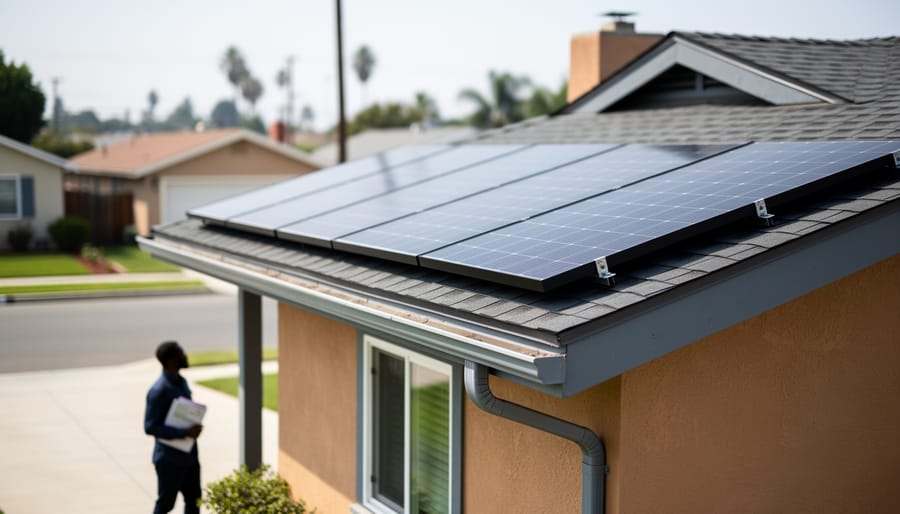
Energy bills represent one of the largest controllable expenses for an inherited Los Angeles home, typically ranging from $150 to $400 monthly depending on size and age. Solar installation can eliminate this cost entirely or reduce it to a minimal grid connection fee, immediately improving your cash flow situation. Understanding how solar works helps clarify why this investment makes financial sense even when you’re already stretched thin.
The 2026 landscape for solar financing options has evolved to specifically address situations like yours. Zero-down programs allow installation with no upfront payment, while Property Assessed Clean Energy (PACE) loans attach to the property rather than requiring your personal credit qualification. The federal Investment Tax Credit still covers 30% of installation costs, and LA solar rebates can add thousands more in savings. These incentives often mean your monthly loan payment is lower than the electricity bill you’re eliminating.
Maria inherited her aunt’s 1,800-square-foot Glendale home in early 2026 with a $340 monthly electric bill she couldn’t sustain. She installed a 7kW solar system through a PACE loan with $0 down. Her electricity costs dropped to $12 monthly for the grid connection fee, while her solar loan payment came to $89 per month. Net result: $239 in monthly savings that transformed an unaffordable property into one she could keep. The system also increased the home’s value by $28,000, giving her equity she didn’t have before.
Additional Cost-Cutting Measures
Beyond solar installation, you can implement several additional measures to bring monthly costs down:
- Appeal your property tax assessment. County assessors sometimes overvalue inherited properties, especially if they haven’t been updated in years. Request a reassessment by filing a formal appeal with the LA County Assessor’s Office within the deadline (typically 60 days from the assessment notice). Bring comparable sales data and any property condition issues. Successful appeals often reduce property tax bills by 10-20%, saving $100-300 monthly.
- Shop for better homeowners insurance. Don’t automatically renew the previous owner’s policy. Get quotes from at least three carriers and ask about discounts for security systems, multiple policies, or claims-free history. Raising your deductible from $500 to $1,000 can cut premiums by 15-25%. Many heirs save $50-150 monthly by switching insurers.
- Create a preventive maintenance schedule. Small repairs prevent expensive emergencies. Schedule annual HVAC servicing, gutter cleaning, and roof inspections. Budget $75-150 monthly for routine upkeep, far less than crisis repairs. If you’ve installed solar panels, remember that solar maintenance matters too, though it’s minimal compared to the energy savings.
- Replace inefficient appliances strategically. If the water heater or HVAC system is over 10 years old, replacing it now with an energy-efficient model prevents breakdowns and cuts utility costs. Focus on the biggest energy consumers first. A new Energy Star water heater alone can save $30-50 monthly.
Combined with solar installation, these measures can reduce your total monthly burden by $400-700, often making an “unaffordable” inheritance completely manageable.
Option 2: Rent Out the Property for Income
Renting out your inherited property can flip the financial equation entirely, instead of draining your bank account each month, the house pays for itself and possibly puts cash in your pocket. This approach works especially well in Los Angeles, where strong rental demand means you can often charge enough to cover all operating costs plus build equity over time.
Start by getting the house rent-ready. Walk through with a critical eye: does it need paint, carpet replacement, or appliance upgrades? Broken fixtures, outdated systems, and deferred maintenance will either scare off quality tenants or justify lower rent. You don’t need luxury finishes, but everything should function properly and look clean. Budget for these upfront costs, they’re investments that directly affect your monthly income.
Before you convert the property to a rental, you’ll need to handle several essential requirements and one-time expenses:
- Landlord insurance policy (typically $1,200-2,000 annually in LA, replacing standard homeowner’s coverage)
- Business license or rental permit from your local city (requirements vary by LA municipality)
- Security deposit account, kept separate from personal funds per California law
- Lease agreement drafted or reviewed by an attorney familiar with California tenant law ($300-800 one-time cost)
- Professional property inspection to identify issues before tenants move in ($400-600)
Next, research realistic rental rates for your area and property type. Check Zillow, and local listings for comparable homes, same neighborhood, similar square footage, comparable condition. In 2026, LA rental markets vary wildly by subregion: a three-bedroom in Silver Lake commands different rates than one in Van Nuys. Price competitively for your first tenant; you can adjust after the initial lease term once you’ve proven the income stream works.
Consider installing solar panels before listing the property. This move accomplishes two things: it slashes your operating costs (the expenses you still cover as owner, like common-area lighting or landscape irrigation), and it becomes a marketable feature that justifies higher rent or attracts better tenants. Renters increasingly value lower utility bills, and you can advertise “reduced energy costs” as a selling point. Many zero-down solar financing options let you start immediately without upfront capital.
Decide whether you’ll self-manage or hire a property manager. Self-management saves the typical 8-10% management fee but demands your time for tenant screening, maintenance calls, rent collection, and legal compliance. Property management companies handle everything, they find tenants, coordinate repairs, enforce lease terms, and deal with evictions if necessary, but they take a cut of your rental income. For out-of-area heirs or those with full-time jobs, professional management often makes financial sense despite the cost.
Understand your obligations as a California landlord: you must maintain habitable conditions, handle repairs promptly, follow strict security deposit rules, provide proper notice before entry, and comply with rent control ordinances in certain LA cities. Ignorance of these laws creates expensive legal problems. Many heirs find that a single consultation with a landlord-tenant attorney (around $300-500) prevents thousands in future headaches.
Run the numbers honestly. Add up monthly costs you’ll still pay (mortgage if any, property tax, insurance, HOA fees, maintenance reserve, management fees) and compare against realistic rental income for your area. If the rent covers everything with a cushion, you’ve solved your affordability problem while keeping the asset. If it falls short by $200-300 monthly, circle back to Option 1, adding solar might close that gap and make the rental strategy viable.
Option 3: Sell the House
Selling may be your cleanest exit if you don’t want the ongoing responsibility or if the numbers simply don’t work. The good news: you’ll likely owe little to no capital gains tax thanks to stepped-up basis rules, which reset the property’s tax value to its worth at the date of death. That means if the house was worth $650,000 when you inherited it and you sell for $655,000, you’re only taxed on the $5,000 gain, not the deceased’s original purchase price decades ago.
Before you list, confirm the probate status. Some estates close quickly with simplified procedures, while others require full court supervision that can stretch months. Contact the executor or estate attorney to verify you have clear legal authority to sell, you can’t close a deal if the title isn’t properly transferred to you first.
Get a realistic valuation by bringing in two or three local agents who specialize in estate sales. They understand that inherited homes often need cosmetic work and can price accordingly. Ask each agent for a comparative market analysis showing recent sales of similar LA properties, and pay attention to days-on-market trends in your specific neighborhood, not citywide averages.
Here’s the typical timeline for selling an inherited property in the 2026 Los Angeles market:
- Complete probate and obtain clear title (2-9 months depending on estate complexity)
- Get property appraised and interview listing agents (1-2 weeks)
- Prepare the home, declutter, clean, handle minor repairs (2-4 weeks)
- List the property and market to buyers (typically 30-60 days to accepted offer in current LA conditions)
- Navigate inspections, appraisals, and buyer financing (30-45 days escrow period)
- Close and receive proceeds (1 day, funds available 2-3 days later)
Total timeline from probate clearance to cash in hand typically runs four to six months for a traditional sale. If you need money faster, consider direct buyer programs or iBuyers who close in two to three weeks, but expect offers 10-20% below market value for that speed.
Choose an agent who won’t pressure you into expensive staging or renovations. Many inherited homes sell perfectly well “as-is” to investors or first-time buyers looking for fixer-uppers. The key is honest pricing and an agent who communicates clearly about your specific constraints and timeline.
Option 4: Transfer or Share Ownership with Family

If other family members want the house but you can’t afford to keep it alone, sharing or transferring ownership can solve the financial burden without losing the property to a stranger. This option works especially well when siblings or relatives have emotional attachment to the home but unequal financial resources.
The simplest transfer is a quitclaim deed, where you sign over your ownership interest to another family member who can afford the carrying costs. This typically requires working with a real estate attorney to draft the deed and file it with the Los Angeles County Recorder’s Office. The recipient may need to refinance any existing mortgage in their name, since most lenders won’t allow you to simply transfer the debt obligation.
Shared ownership, where you remain a co-owner with one or more family members, requires more structure but splits the financial load. You’ll need a written co-ownership agreement that specifies each person’s ownership percentage, who pays which expenses, how decisions get made, and what happens if someone wants out later. This agreement should be legally binding and recorded.
Tax implications depend on how you structure the transfer. Gifting your share to a family member may trigger gift tax if the equity exceeds annual exclusion limits. Selling your share to them at fair market value avoids gift tax but may create capital gains. Consult a CPA familiar with estate transfers before proceeding.
Solar installation strengthens shared ownership arrangements by permanently reducing operating costs for everyone. When monthly expenses drop by $200-300 through eliminated electricity bills, co-owners face lower ongoing obligations, making the agreement more sustainable long-term. Some families finance solar collectively as part of the co-ownership structure, turning a cost burden into a value-building investment that benefits all parties equally.
Option 5: Deed the Property to a Charity or Disclaim the Inheritance
When you’ve exhausted every option to make the inherited property work financially, two last-resort paths remain: donating it to charity or disclaiming the inheritance entirely.
Donating to a Qualified Charity
You can deed the property directly to a 501(c)(3) charitable organization and potentially claim a tax deduction for the fair market value. This works best when the house has substantial equity but you simply can’t manage the carrying costs. Contact the charity first, not all nonprofits accept real estate donations, and many have specific criteria about property condition and location. You’ll need a qualified appraisal for IRS purposes if the value exceeds $5,000, and the charity typically handles the sale after transfer. This option lets you turn an overwhelming burden into a charitable contribution while eliminating the stress, even if you move later and the organization decides to sell.
Disclaiming the Inheritance
A disclaimer means you formally refuse the inheritance, and the property passes to the next heir in line (or according to state intestacy laws if no will exists). This completely removes you from any financial obligation.
You cannot disclaim after you’ve already taken ownership actions like moving in, collecting rent, or making improvements. Work with an estate attorney to file the proper disclaimer documents with the probate court. This path makes sense when the property has negative equity or the costs clearly exceed any benefit to you or your family.
How to Verify You’ve Made the Right Choice
After implementing your chosen solution, track these concrete indicators to confirm it’s working:
Monthly Cash Flow: Your inherited property decision is successful if your monthly out-of-pocket costs are declining or eliminated. Calculate total expenses (utilities, insurance, property tax, maintenance) minus any income (rental payments, tax savings). If you went the solar route, your utility bill should drop within the first full billing cycle, typically $150-400 less in Los Angeles. Document these numbers in a simple spreadsheet for three months to establish your new baseline.
Stress and Time Investment: A working solution reduces your anxiety and time commitment, not increases it. If you’re spending more hours managing the property or losing sleep over finances three months in, that’s a signal to pivot. The right choice should feel progressively easier, not harder.
Key success indicators for each option:
– Option 1 (Cost Reduction): Monthly expenses cut by at least 30%, solar system producing expected kWh, no new maintenance emergencies
– Option 2 (Rental): Tenant paying on time, rental income covers all property costs plus 10% buffer, minimal landlord calls
– Option 3 (Sale): Property listed within 60 days, offers received at or above asking, closing progressing on schedule
– Option 4 (Shared Ownership): Co-owners paying their share consistently, clear communication, no resentment building
– Option 5 (Donation/Disclaimer): Legal process completed, tax documentation received, mental relief achieved
Set a 90-day review checkpoint. If your tracked metrics aren’t improving or you’re seeing warning signs, missed payments, unexpected costs, family conflict, mounting debt, don’t wait. Revisit your options immediately. Many homeowners successfully combine strategies, like installing solar before selling to command a higher price, or cost-cutting for six months before deciding whether to rent or sell.
Frequently Asked Questions
You’re not required to accept an inherited house, and you have more time to decide than you might think, but certain choices come with deadlines you can’t miss. Here are the answers to the most common questions heirs face when dealing with an unaffordable inherited property.
Do I have to accept an inherited house?
No. You can disclaim an inheritance in California, but you must file a written disclaimer within nine months of the owner’s death, and you can’t have already accepted any benefits from the property.
What happens if I just walk away from the house?
Walking away without formal action can lead to property liens, tax penalties, and damage to your credit if there’s an outstanding mortgage. The property may eventually go to foreclosure or tax sale, but you’ll face legal and financial consequences along the way.
Can I get solar panels with no money down on an inherited property?
Yes. Many California solar programs offer zero-down financing options including PACE loans that attach to the property, not your credit, making them accessible even during the probate period.
How long do I have to decide what to do?
There’s no universal deadline for making a final decision, but disclaimer deadlines are nine months, and probate typically must be completed within 12-18 months. Property taxes and utilities continue accumulating regardless of your timeline.
What if there’s a mortgage I can’t afford?
You can sell the house to pay off the mortgage, negotiate with the lender for a loan modification, or disclaim the inheritance before taking ownership. You’re not personally liable for the debt unless you formally assume the mortgage.
Will I owe taxes on the inheritance?
California has no inheritance tax, and the federal estate tax only applies to estates over $13.61 million in 2026. You will owe capital gains tax if you sell the property for more than its stepped-up basis value at the date of inheritance.
Can I live in the house while deciding?
Yes, but living there may be considered accepting the inheritance, which can eliminate your option to disclaim. Consult an estate attorney before moving in if you’re unsure about keeping the property.
What’s the biggest mistake heirs make?
Letting the house sit vacant without maintaining insurance, utilities, or security. This leads to damage, liability issues, and rapidly increasing costs that make an already unaffordable situation worse.
The key thing to remember is that inaction is itself a decision, usually the most expensive one. Even if you’re leaning toward disclaiming or donating the property, you’ll need to maintain it and cover basic costs until the legal process is complete. Getting clarity on your actual monthly expenses and exploring cost-reduction options like solar gives you breathing room to make the choice that’s truly right for your situation, not just the quickest escape route.
An inherited house doesn’t have to drain your finances or force you into a corner. You’ve got five solid pathways forward, and each one can work depending on your situation and goals.
For Los Angeles homeowners, solar power stands out as the game-changer. What looks like an unaffordable burden today, with $200, $300, even $400 monthly energy bills, can become a manageable asset once you eliminate that expense. We’ve seen it happen dozens of times: heirs who were ready to sell discover that solar installation flips the math entirely, letting them keep a valuable property that can appreciate or generate rental income for years.
The key is understanding your numbers before you make any permanent decisions. A free solar assessment shows you exactly how much you can cut from your monthly costs, often with zero upfront investment. That clarity helps you choose the right option with confidence instead of acting out of stress.
LA Solar Map specializes in helping inherited property owners navigate exactly this scenario. We’ll walk you through your specific situation, show you the real costs and savings, and help you make a decision you won’t regret. Contact us today for a personalized consultation, let’s turn that inherited burden into an opportunity.

